What You Need to Know About Post-Consumer Recycled (PCR) Packaging
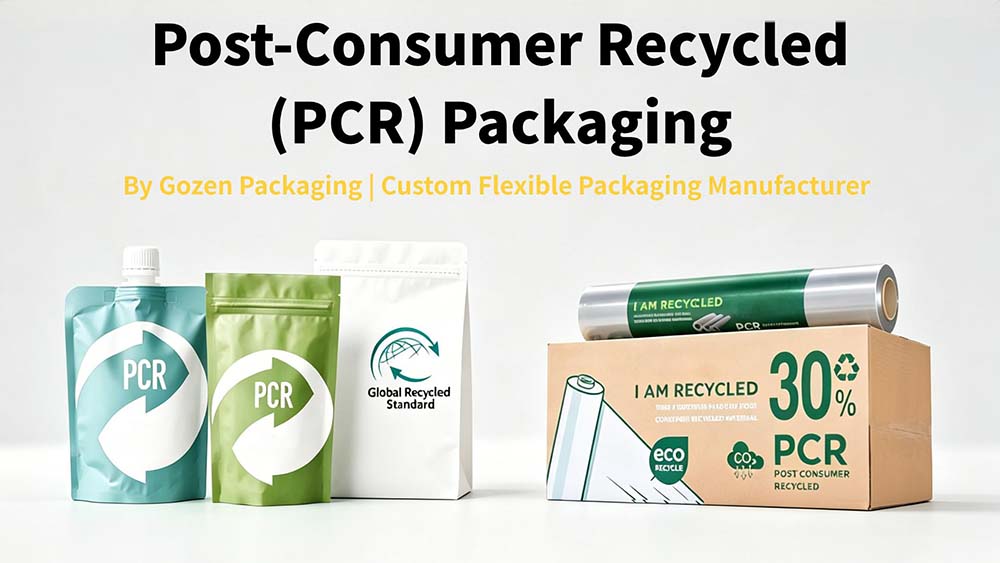
Walmart, Target, Amazon, and major European grocery chains now require packaging suppliers to report recycled content percentages. Products that do not meet thresholds face lower vendor ratings and shelf placement penalties.
The metric being measured is post-consumer recycled content, abbreviated as PCR. Gozen Packaging manufactures PCR flexible packaging at 15 to 50 percent recycled content for food, pet care, supplement, and cosmetic brands. This article explains what PCR is, how it performs, and how to specify it correctly for your packaging.
1. What PCR Packaging Actually Is
Post-Consumer vs Post-Industrial: The Distinction Matters
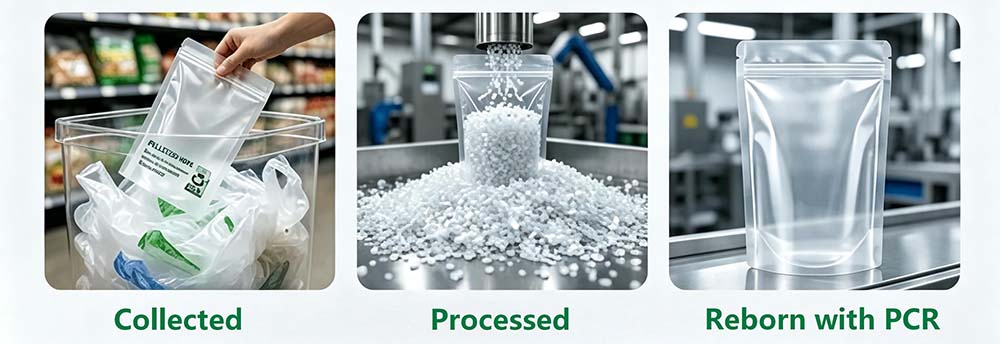
PCR stands for post-consumer recycled content. The material originates from products that consumers used, discarded, and entered a municipal recycling stream. A plastic milk jug collected from a curbside bin, sorted at a materials recovery facility, washed, ground, and pelletized becomes PCR resin.
This is distinct from PIR, or post-industrial recycled content. PIR comes from manufacturing scrap: edge trim from a film converting line, rejected bottles from a blow molding plant, or overruns from a print job.
PIR has value as a waste reduction measure, but it does not count toward PCR content targets in most retailer sustainability programs or regulatory frameworks. The supply chain that collects, sorts, and reprocesses consumer-used material is what gives PCR its environmental credibility, and also what makes it more expensive than PIR or virgin resin.
How PCR Resin Moves from Curbside Bin to Packaging Film
The PCR supply chain for flexible packaging starts with post-consumer polyethylene waste, predominantly LDPE and LLDPE from film and bag collection programs.
The material is baled, transported to a wash line where contaminants including paper labels, adhesives, and food residue are removed, then extruded into pellets. The resulting PCR resin is tested for melt flow index, density, and contamination level before release to film converters.
In PCR flexible packaging, the recycled pellets are blended with virgin resin at a specified percentage, typically 30 to 50 percent for applications requiring consistent seal strength, and extruded into film.
The film can then be printed, laminated, and converted into stand-up pouches, pillow bags, or other formats on standard converting equipment. The finished package looks and functions like a virgin-material pouch. The difference is invisible to the consumer and material to the retailer’s sustainability scorecard.
2. Why Brands Are Adopting PCR Packaging Now
Retailer Sustainability Scorecards Are Reshaping Shelf Placement
Walmart’s Project Gigaton requires suppliers to report packaging composition, recycled content, and recyclability. Target’s Sustainable Packaging Goals set recycled content targets across owned brands and national brand suppliers. Amazon’s Climate Pledge Friendly program gives preferential search placement to products meeting specific packaging criteria.
In Europe, the Packaging and Packaging Waste Regulation (PPWR) mandates minimum recycled content percentages for plastic packaging starting in 2030, with interim targets from 2025.
The common thread across these programs: PCR content is the metric being measured. A brand that switches to packaging with 30 percent PCR content meets the threshold for improved vendor ratings on multiple retailer scorecards simultaneously. A brand that stays with 100 percent virgin material watches its shelf placement decline relative to competitors who made the switch.
Consumer Purchase Behavior Is Tracking Sustainability Claims
Multiple consumer surveys conducted between 2022 and 2025 consistently report that 60 to 70 percent of shoppers in the 25 to 44 age bracket consider packaging sustainability when choosing between comparable products. The “made with recycled materials” claim on a food packaging pouch is the single most recognized and trusted on-pack sustainability claim according to consumer perception research.
It ranks above “compostable,” above “biodegradable,” and above “recyclable” in consumer trust surveys. The reason is simple: PCR means material was actually recycled and used again. The claim describes an action that already happened, not a promise about what might happen after disposal.
3. Performance Considerations for PCR in Flexible Packaging
Film Strength and Seal Integrity with Recycled Content
PCR resin introduces variability. Each batch of post-consumer material carries slightly different molecular weight distribution, slightly different contamination profiles, and slightly different processing behavior compared to virgin resin.
A film converter that simply substitutes PCR pellets for virgin pellets on the same extrusion settings will encounter inconsistent gauge control, haze variation, and seal strength fluctuation across the production run.
Gozen addresses this through incoming resin testing and extrusion parameter adjustment per PCR batch. Melt flow index and density are verified before the material enters production. Extruder temperature profiles, screw speed, and draw ratio are adjusted to compensate for the rheological differences between PCR and virgin PE.
The result is a PCR stand-up pouch that performs within the same seal strength and dimensional tolerance as a virgin-material pouch. The conversion process absorbs the variability so the finished package does not reflect it.
Print Quality on PCR Film Substrates
PCR film tends toward a slightly darker base tint than virgin PE film because trace pigments from the recycled material input cannot be completely removed during reprocessing. This affects the white point of the printed result. For designs with heavy ink coverage and dark backgrounds, the difference is negligible.
For designs with large white areas or pastel color fields, the print operator compensates with a white base layer to bring the substrate white point to target before printing the color layers.
On custom printed PCR bags, Gozen adjusts the ink laydown sequence to accommodate the PCR substrate’s optical properties. The print result is matched to the brand’s approved color standard under controlled lighting conditions. The consumer sees the same color. The spectrophotometer reading confirms it. The difference is in the press setup, not in the visual output.
4. Regulatory and Certification Requirements
What Counts as PCR for Labeling Claims
Not all recycled content claims are equal. A package labeled “contains recycled material” without specifying the source, percentage, or certification standard is making an unverifiable claim that retailers and regulators increasingly reject.
The credible claim format specifies the recycled content source (post-consumer), the percentage (30 percent), and the verification method (certified by third party or supported by mass balance accounting).
For PCR content, chain of custody certification provides the verification. The two dominant standards are the Recycled Content Certification from SCS Global Services and the EuCertPlast certification for European post-consumer plastics recyclers.
Both require auditable traceability from the recycling facility through each intermediate handler to the finished packaging converter. Gozen provides documentation tracing PCR resin lots to certified recycling sources upon request.
Regional Differences in PCR Requirements
The regulatory landscape fragments by region. The EU PPWR sets specific PCR content minimums for plastic packaging: 10 percent for contact-sensitive packaging by 2030, rising to 50 percent by 2040. The UK Plastic Packaging Tax applies a levy of approximately GBP 218 per metric ton on plastic packaging with less than 30 percent recycled content.
California’s SB 54 requires all single-use packaging to be recyclable or compostable by 2032, with specific recycled content thresholds. A brand selling into multiple regions must track which PCR percentage satisfies which jurisdiction. Sustainable packaging solutions from Gozen are specified to the target market’s regulatory threshold, not a one-size-fits-all percentage.
5. How to Specify PCR Content for Your Packaging
Realistic Percentage Targets by Application
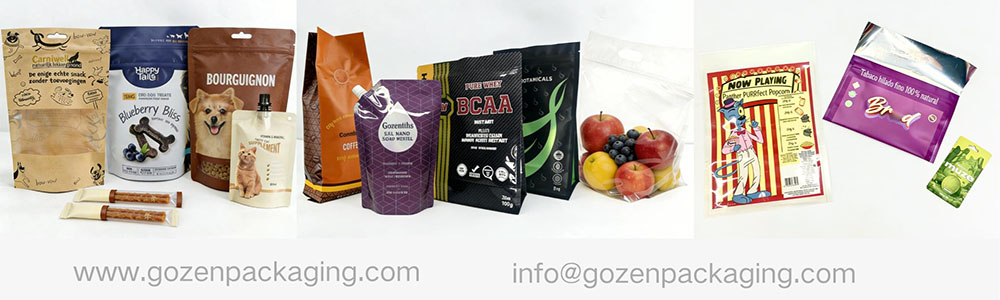
Not every packaging application can accept high PCR content without performance trade-offs. The target percentage depends on the package’s functional requirements:
- Stand-up pouches for dry foods (coffee, snacks, tea): 30 to 50 percent PCR content is achievable with no measurable change in barrier performance or seal strength.
- Frozen food packaging: 20 to 40 percent PCR content. Cold-temperature seal strength is the limiting factor. Higher percentages require additional virgin resin in the sealant layer.
- Pet food and heavy-fill applications: 20 to 35 percent PCR content. Puncture resistance and drop test performance dictate the upper limit.
- Liquid and high-barrier applications: 15 to 30 percent PCR content. The barrier layer and sealant layer require virgin material to maintain integrity under headspace pressure and sterilization conditions.
These percentages represent what Gozen has validated through production runs and third-party lab testing, not theoretical maximums. Each application is quoted based on the specific product weight, fill temperature, distribution conditions, and shelf life target.
A brand requesting 50 percent PCR for a heavy-fill pet food pouch will receive a test recommendation rather than a yes or no. The answer depends on the product. The test data determines the specification.
Cost Comparison: PCR vs Virgin Material
PCR resin currently trades at a 10 to 30 percent premium over virgin polyethylene on a per-kilogram basis, depending on grade, region, and market conditions. The premium reflects the collection, sorting, washing, and reprocessing cost that virgin resin production does not incur.
A brand budgeting for a PCR switch should expect a 5 to 12 percent increase in total pouch cost when moving from 0 to 30 percent PCR content, accounting for the blended resin price and the additional quality control steps required.
This cost increase is partially offset by retailer benefits: improved vendor ratings on sustainability scorecards, qualification for programs like Amazon Climate Pledge Friendly that improve search placement, and avoidance of plastic packaging taxes in jurisdictions where they apply.
For pet food packaging and coffee bag brands selling through major retail channels, the retailer compliance benefit alone typically exceeds the incremental packaging cost. The sustainability claim on the package is the visible outcome. The retailer scorecard improvement is the financial justification.
6. PCR in Context: Other Sustainable Packaging Paths
Mono-Material Recyclable Structures
PCR addresses the input side of the packaging sustainability equation: using recycled material to make new packaging.
Mono-material recyclable structures address the output side: designing the package so it can be recycled after use.
A recyclable LDPE laminated bag made from a single polymer family can enter the polyethylene recycling stream without requiring layer separation. Gozen offers mono-PE and mono-PP structures that qualify for store drop-off recycling programs under How2Recycle guidelines.
Combining PCR with Recyclable Design
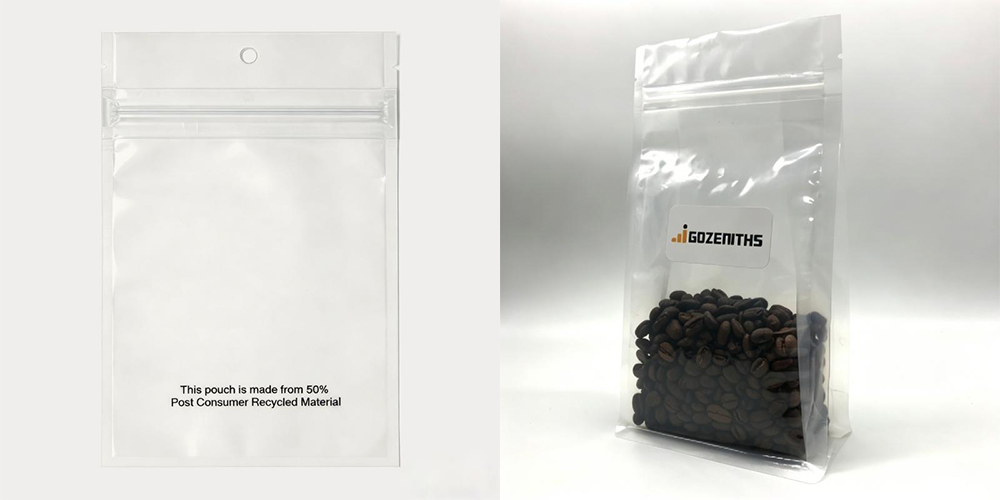
The most advanced packaging specification uses PCR content in a mono-material structure. The package contains recycled material on the input side and is designed for recycling on the output side. For example: a 30 percent PCR, 100 percent mono-PE stand-up pouch with a PE-compatible zipper. The pouch contains post-consumer material and, after use, can be returned to the PE recycling stream.
This specification satisfies both the recycled content mandate and the recyclability requirement that appear together in the most stringent retailer and regulatory frameworks. Gozen has produced this configuration at commercial scale for food brands across North America and Europe.
Specify PCR Content for Your Next Packaging Order
Gozen Packaging manufactures PCR flexible packaging at percentages from 15 to 50 percent post-consumer recycled content, depending on application requirements. Our PCR resin supply chain is traceable to certified recycling sources.
Production capabilities include rotogravure and digital printing, multi-layer and mono-material structures, and full quality control documentation including PCR chain of custody records. Minimum order quantities start at 3,000 units for digital print runs with PCR content. All PCR packaging is supported by batch-level recycled content certification documentation.
Contact Gozen for PCR Packaging Specifications and Pricing
Learn more: PCR Packaging Bags | Sustainable Packaging Solutions | Recyclable Mono PE Bags | Case Studies